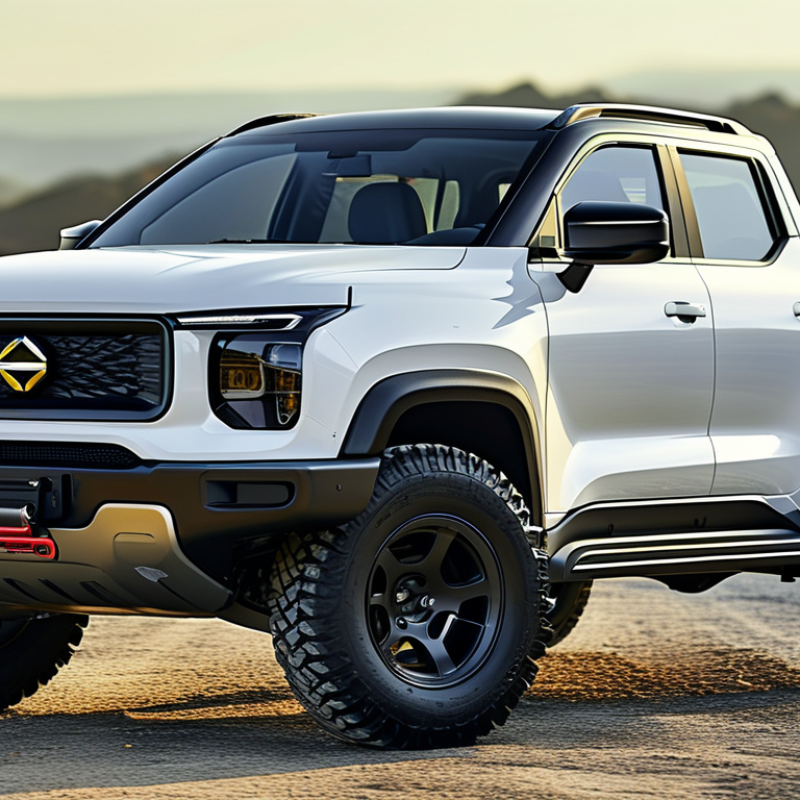
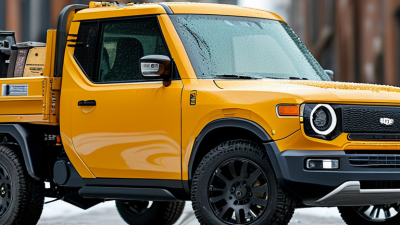
When it comes to choosing a reliable Electric Mini Pickup supplier in China, it’s really about more than just comparing prices in catalogs. Global buyers should look for solid proof of manufacturing experience, export capacity, consistent product quality, and quick support. Think of this guide as your cheat sheet—it highlights well-established manufacturers and specialized suppliers, including names like Foton Motor, Changan Auto, and Dongfeng. Just keep in mind, product availability can vary depending on the market, so details really do matter.
A practical approach involves digging into several key factors—like the type of battery chemistry, how long it takes to charge, driving range, payload capacity, cargo bed size, and how the vehicle handles rough roads. Don't just take their word for it—ask for recent test reports, factory videos, sample units, and clear warranty info. Sometimes, a pickup looks super capable in photos or brochures but might perform differently when loaded with, say, 500 kilograms or when driving in hot and humid weather. That’s something to keep in mind. Conducting supplier audits, checking references, and even arranging independent inspections can help you avoid costly mistakes. Make sure all the compliance paperwork matches the requirements of your destination country—vehicle standards, batteries, safety regulations, and import rules. And always verify claims rather than just taking them at face value.
Basically, it’s important to choose suppliers who can clearly explain their manufacturing processes, keep communication smooth, and help plan for spare parts. After-sales support is especially crucial if your vehicles are going to be working far from big cities. Ask about things like battery replacements, availability of controllers, software support, and technician training. No one’s perfect—some companies might offer great customization options but have less experience with exports, while others might have better documentation but fewer body style choices. The best fit depends on your specific needs: operational conditions, order size, budget, and local regulations. Taking the time to compare options carefully means you’ll be more likely to move from an attractive quote to a reliable, long-term fleet solution.
A Mini Electric Pickup Truck is a compact utility vehicle powered by a rechargeable battery. It usually combines a short cargo bed, low operating costs, and simple urban handling. Unlike a full-size electric truck, it serves lighter transport tasks in crowded districts, farms, campuses, and industrial parks. Small footprint matters. Operators can load cartons, tools, produce, or maintenance equipment without requiring a large commercial vehicle. Typical evaluation should cover payload, usable battery capacity, charging time, range under load, and corrosion protection. A claimed driving range may fall sharply when roads are steep, temperatures are low, or cargo reaches the rated limit.
In global markets, these vehicles support last-mile delivery and local service fleets. Their quiet operation can reduce disturbance near housing areas and public facilities. Buyers also examine steering position, charging standards, spare-part access, warranty terms, and technician training. A responsible supplier should provide test records, clear manuals, battery safety data, and documentation for the destination market. Local registration and road-use requirements still need independent verification. That step is easy to overlook. From practical fleet assessments, predictable uptime often matters more than the lowest purchase price. A vehicle that waits hours for charging can weaken delivery schedules. Buyers should also question whether small batteries, basic suspension, or limited cabin protection suit their climate and roads. The compact format is useful, but it is not universally suitable. Painful lessons usually come from matching paper specifications with real daily routes.
When comparing Chinese electric mini pickup suppliers, buyers should examine specifications beyond advertised range. Start with payload, bed dimensions, curb weight, and maximum gradeability. A compact truck carrying 500 kilograms may perform differently on steep roads or uneven worksites. Ask for measured range under a stated load, temperature, speed, and road condition. Battery chemistry, usable capacity, charging time, and battery warranty also deserve close attention.
Motor power is important, but torque delivery can matter more during low-speed hauling. Check whether the vehicle uses hydraulic or electric steering, disc or drum brakes, and an independent suspension system. Ground clearance, turning radius, water resistance, and tire size affect daily usability. Request test reports, production records, and clear information about spare-part availability. A reliable supplier should explain quality-control steps instead of offering vague promises. Specifications can look impressive. Real conditions may disagree.
Tips: Compare the same test conditions across suppliers. Ask for a loaded driving demonstration, not only showroom photos. Confirm charging compatibility with your local power system. Review warranty exclusions carefully, especially for batteries and controllers. Inspect sample welds, panel alignment, cable protection, and dashboard warnings before ordering. It is easy to overlook after-sales training, and that mistake can become expensive. Pay attention to response speed and document accuracy; these details often reveal how a supplier handles problems.
China’s L7e Electric Pickup supply base includes vehicle manufacturers, contract assemblers, component integrators, and export trading companies. Each type serves a different buyer. Vehicle manufacturers usually control chassis design, battery integration, and quality systems. Contract assemblers offer flexible specifications and lower minimum orders. Trading companies can combine several factories, but technical accountability may become unclear.
Regional strengths are concentrated rather than uniform. Shandong has many producers of compact utility vehicles and light commercial platforms. Jiangsu and Zhejiang support electric drivetrains, wiring, body parts, and small-batch assembly. Guangdong is stronger in batteries, controllers, lighting, and electronics. Anhui and neighboring provinces provide growing manufacturing capacity and logistics access. Factory visits still matter. A clean showroom proves little.
The China Association of Automobile Manufacturers reported 9.495 million new-energy vehicle sales in 2023, representing 31.6% of total vehicle sales. The International Energy Agency also reported that China produced more than half of the world’s electric cars in 2023. These figures show industrial depth, not automatic pickup quality. Buyers should request battery test records, payload measurements, brake evidence, and production traceability. European L7e classification may impose specific limits on speed, mass, dimensions, and approval procedures. Requirements differ by destination. Export documents often need closer checking than expected. This is where inexperienced sourcing plans can fail. A supplier may quote a capable prototype, then deliver a weaker commercial configuration. Independent inspection remains sensible.
China’s electric mini pickup sourcing ecosystem typically includes vehicle assemblers, chassis and body manufacturers, battery and electric powertrain suppliers, and utility-body integrators. Major manufacturing activity is concentrated in the Yangtze River Delta, Pearl River Delta, Bohai Rim, Central China, and Southwest China. The chart below provides official national NEV production and export context for 2023–2024; it does not represent any individual company or brand.
Data source: China Association of Automobile Manufacturers (CAAM). Figures are total new-energy vehicle production and exports in China, measured in millions of vehicles. Regional and supplier-type descriptions are qualitative industry classifications rather than company-level market shares.
For global buyers, a Small Electric Pickup must match real work, not showroom numbers.
The IEA’s Global EV Outlook 2024 reported nearly 14 million electric car sales in 2023. This growth improves battery supply, but utility vehicles still face heavier loads and rougher routes. Battery capacity is only one measure. Buyers should check usable kilowatt-hours, battery chemistry, thermal management, and warranty terms. A 30 kWh pack may suit urban deliveries, yet hills, winter temperatures, and cargo can reduce practical range.
Charging access deserves equal attention. The IEA recorded more than four million public charging points worldwide at the end of 2023. However, many work sites lack reliable overnight charging. Confirm the connector standard, onboard charger rating, charging time, and local electrical capacity.
BloombergNEF’s 2024 Battery Price Survey placed the average lithium-ion pack price at 115 US dollars per kWh. Lower prices can help, but cheaper packs may not deliver better cycle life or safety. Payload is easy to misunderstand. Ask for rated payload with passengers, tools, and accessories included. Towing may reduce range sharply.
China’s electric mini pickups attract global buyers, but export compliance starts with vehicle classification. An L7e Electric Pickup Truck is not automatically road-legal overseas. Under EU Regulation 168/2013, L7e vehicles generally face a 15 kW maximum continuous rated power limit. Mass limits also vary by passenger or cargo configuration. Confirm the category before signing a purchase contract.
The IEA Global EV Outlook 2024 reported nearly 14 million electric car sales in 2023, increasing pressure on regulators and customs authorities. Export files should include the commercial invoice, packing list, certificate of origin, VIN records, and battery transport documents. Lithium batteries also need UN 38.3 testing evidence and a test summary. For European registration, buyers may need type approval, electromagnetic compatibility checks, braking tests, lighting compliance, and proof of conformity. Small details matter.
Import rules differ sharply outside Europe. The United States does not simply accept the L7e category; the vehicle may require NHTSA compliance, FMVSS certification, and EPA requirements. Australia, the United Kingdom, and Gulf markets apply different approval pathways. The EU Battery Regulation may also create producer-registration and battery information duties. A spreadsheet can look complete and still hide a missing certificate. I have seen delivery schedules fail because the cargo battery documents arrived late. Pre-shipment document review is slower, but usually cheaper than port storage.
| Evaluation Dimension | What Global Buyers Should Verify | Typical Evidence or Document | Commercial Importance |
|---|---|---|---|
| Vehicle classification | Confirm whether the vehicle is classified as a road vehicle, low-speed vehicle, off-road utility vehicle, or a goods vehicle in the destination market. | Technical specification sheet, vehicle category statement, homologation plan, and proposed customs classification. | Classification determines road access, testing, registration, taxes, insurance, and the applicable safety rules. |
| Chinese export readiness | Check that the exporter can legally conduct foreign trade and can issue consistent commercial and transport documents. | Business registration details, foreign-trade operator record where applicable, export contract, commercial invoice, packing list, and customs declaration data. | Incomplete exporter information can delay customs clearance and payment processing. |
| China domestic conformity | Determine whether the vehicle is subject to China compulsory certification or other applicable domestic vehicle requirements before export. | Applicable certification record, test reports, product conformity statement, and vehicle identification information. | Domestic compliance evidence supports product traceability but does not automatically approve the vehicle for another country. |
| Battery safety documentation | Verify battery chemistry, nominal voltage, capacity, pack configuration, protection system, charging limits, and thermal-management design. | Battery specification, safety test report, battery management system description, SDS, and installation or service manual. | Battery information affects dangerous-goods transport, vehicle approval, warranty risk, and after-sales servicing. |
| International battery transport | For lithium-ion batteries, confirm compliance with applicable air, sea, road, and rail dangerous-goods rules. | UN 38.3 test summary, battery packing instruction, dangerous-goods declaration where required, and transport labels. | UN 38.3 evidence is commonly required for transporting lithium batteries and does not replace vehicle type approval. |
| European Union market access | Identify the applicable EU vehicle category and obtain the relevant whole-vehicle type approval or individual approval before road registration. | EU type-approval documentation, certificate of conformity where applicable, technical file, VIN records, and required test reports. | A general CE marking alone is not a substitute for EU motor-vehicle type approval. |
| EU battery obligations | Review obligations for battery information, producer responsibility, labeling, recycling, carbon-footprint data, and supply-chain due diligence as applicable to the product and importer. | Battery technical file, labeling artwork, recycling arrangements, supplier declarations, and importer compliance plan. | The EU Battery Regulation creates responsibilities for economic operators beyond ordinary vehicle customs clearance. |
| United States market access | Determine whether the vehicle is a federally regulated motor vehicle, a low-speed vehicle, or an off-road product, then verify applicable safety, emissions, and registration rules. | Manufacturer self-certification records, Federal Motor Vehicle Safety Standards compliance evidence, import declarations, and state registration documentation. | The United States generally uses manufacturer self-certification for federal vehicle safety compliance; imported vehicles may also face emissions and state-level requirements. |
| United Kingdom market access | Confirm whether GB type approval, individual vehicle approval, or another approval route applies; Northern Ireland may follow different arrangements. | Approval certificate, conformity documents, VIN evidence, technical specifications, and registration support documents. | Approval and registration procedures differ from those in the EU and should be confirmed before shipment. |
| Australia market access | Check applicable Australian Design Rules, vehicle category, roadworthiness requirements, and the intended state or territory registration pathway. | Road-vehicle approval records, compliance evidence, identification documents, and importer or registered-operator declarations. | Approval requirements can depend on vehicle type, intended use, and the importer's registration pathway. |
| Gulf and other markets | Verify national or regional conformity requirements, local safety standards, charging compatibility, climate suitability, and registration rules. | Certificate of conformity, laboratory reports, Arabic or local-language labels where required, and local authority approval. | A vehicle approved in one market is not automatically approved across all countries in the region. |
| Customs classification | Obtain a destination-country tariff ruling or broker confirmation for the complete vehicle, spare batteries, chargers, and parts. | HS classification proposal, customs ruling where available, commercial invoice, packing list, and product photographs. | Electric goods vehicles may fall under HS heading 8704, but the final tariff code and duty rate depend on destination-country rules and vehicle specifications. |
| Rules of origin and trade remedies | Check preferential trade agreements, non-preferential origin rules, additional duties, quotas, and trade-remedy measures applicable to Chinese-origin electric vehicles. | Certificate or declaration of origin, bill of materials, production records, and customs-origin statement. | Origin treatment can materially change the landed cost and may require substantial supporting records. |
| Charging compatibility | Confirm charger input voltage, frequency, connector type, charging protocol, onboard charger rating, and local electrical safety requirements. | Charger datasheet, wiring diagram, installation instructions, electrical test report, and destination-market plug configuration. | A vehicle can be technically operable but commercially unsuitable if the charger is incompatible with local infrastructure. |
| Safety and performance testing | Review braking, lighting, restraint systems, electromagnetic compatibility, crash performance, payload, range, and water or dust protection according to the target market. | Independent laboratory reports, test conditions, engineering drawings, calibration records, and production inspection reports. | Supplier claims should be matched with test methods, tolerances, and the exact vehicle configuration being purchased. |
| Quality-management capability | Assess production controls, incoming inspection, battery traceability, end-of-line testing, change management, and corrective-action procedures. | Quality manual, audit reports, process-control plan, inspection checklist, serial-number records, and relevant management-system certificates. | A management-system certificate supports process evaluation but does not prove that a vehicle is approved for road use. |
| Warranty and after-sales support | Define battery warranty limits, mileage or time coverage, exclusions, spare-parts availability, diagnostic access, repair training, and response times. | Signed warranty policy, parts catalogue, service manual, diagnostic procedure, escalation contacts, and service-level agreement. | Local support is especially important for battery, controller, charger, braking, and software-related failures. |
| Shipment and delivery terms | Clarify whether the vehicle is shipped fully assembled, partially disassembled, or as a kit, and assign responsibility for export clearance, freight, insurance, and import clearance. | Signed Incoterms® rule, shipping instructions, container-loading plan, insurance certificate, bill of lading, and delivery schedule. | Incoterms® rules allocate costs and responsibilities but do not determine product conformity or import eligibility. |
| Pre-shipment inspection | Inspect the exact production batch for quantity, VIN, battery serial number, configuration, accessories, charging equipment, and visible damage. | Inspection report, photographs, battery state-of-charge record, functional test results, and signed acceptance checklist. | Pre-shipment verification reduces disputes over specification deviations and missing components. |

Choosing an electric mini pickup supplier requires more than comparing online prices. Request battery capacity, payload, range, charging time, and gradeability in writing. Ask for test reports and production photos. A serious supplier should explain motor output, frame materials, and water protection clearly. During a sample inspection, check welds, panel alignment, tire wear, and brake response. Small details reveal factory discipline.
Pricing should include the vehicle, battery, charger, spare parts, packaging, and shipping terms. A low quotation may hide expensive replacement batteries or limited accessories. I have learned that warranty wording often matters more than the warranty period. Confirm coverage for the motor, controller, battery, charger, and chassis separately. Ask who pays transport for defective parts and how quickly technical staff respond. Written service procedures are more reliable than friendly promises.
Tips: Request a sample unit before bulk ordering. Record cold-start performance and charging time. Ask for a parts list with prices. Check whether support is available in your language and time zone. Supplier claims can be incomplete, so independent inspection remains worthwhile. No factory is perfect. A transparent supplier should admit limitations and explain corrective action. Also confirm that the vehicle can meet your destination’s safety, road-use, battery transport, and import requirements.
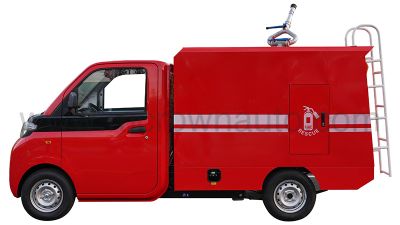
The Reach T30 Electric Fire Engine combines smart engineering with factory-direct value for community services, industrial areas, old towns, and forest firefighting. The International Energy Agency’s *Global EV Outlook 2024* reported nearly 14 million electric cars were sold worldwide in 2023, reflecting growing confidence in electric mobility and battery technology. Applying this progress to firefighting, the vehicle uses an integrated energy recovery system, battery-pack heating, ABS, and EBD to support efficient, stable operation in demanding environments. Its automatic climate-control air conditioning and double shock absorption system—combining a shock absorber with a suspension spring—help maintain crew comfort on uneven roads.
Built with commercial-vehicle manufacturing processes and 18 patented technologies, the vehicle delivers automotive-grade craftsmanship from a China-based factory supplier. A turning radius of no more than 5.4 meters enables quick U-turns and smooth access through narrow alleys, a valuable capability as urban response routes become increasingly congested. NFPA’s *U.S. Fire Department Profile* reports that emergency departments respond to tens of millions of calls annually, with medical and community-related incidents forming a substantial share, highlighting the need for versatile response vehicles. Ergonomic seating, central locking, heated and cooled air conditioning, and electric windows support extended operations, while direct factory supply enables tailored configurations, consistent quality control, and efficient procurement for municipal, industrial, and rural firefighting teams.
Vehicle manufacturers manage chassis, batteries, and quality systems. Assemblers offer flexible specifications and smaller orders. Trading companies combine factories, but technical responsibility may become unclear.
Shandong supports compact utility vehicles and light commercial platforms. Jiangsu and Zhejiang supply drivetrains, wiring, body parts, and assembly. Guangdong is stronger in batteries, controllers, lighting, and electronics.
Request battery records, payload measurements, brake evidence, and production traceability. Visit the factory if possible. A clean showroom proves little.
Check usable energy, battery chemistry, thermal management, and warranty terms. A 30 kWh battery may suit city routes. Hills, winter weather, and heavy cargo reduce range.
Confirm the connector, charger rating, charging time, and site electrical capacity. Many work areas lack dependable overnight charging. Test charging at your own location.
Ask for rated payload with passengers, tools, and accessories included. Test the vehicle fully loaded. Towing can reduce range sharply. Axle limits matter too.
Prepare the invoice, packing list, origin certificate, vehicle identification records, and battery transport documents. Battery testing evidence and a test summary may also be required.
No. Approval depends on the destination. Requirements may cover power, mass, dimensions, braking, lighting, emissions, and electromagnetic compatibility. Check classification before signing.
Review all documents before shipment. Check registration duties, battery information requirements, and local approval routes. A complete spreadsheet may still hide one missing certificate.
Confirm service training, spare-parts lead times, battery diagnostics, and warranty handling. Specifications can look excellent but fail during daily work. I may overvalue paperwork sometimes; real testing matters more.
Electric Mini Pickup trucks are becoming practical solutions for urban delivery, agricultural work, light industrial transport, and last-mile logistics in global markets. Chinese suppliers offer a wide range of compact electric vehicles, with differences in motor power, battery chemistry, cargo-bed dimensions, payload capacity, driving range, safety features, and vehicle configuration. Buyers should compare battery capacity, charging time, charging standards, operating temperature, hill-climbing ability, and expected performance under real load conditions rather than relying only on advertised specifications.
Supplier selection should also consider manufacturing experience, production region, quality-control systems, customization capabilities, and export documentation. Before placing an order, international buyers should confirm applicable certifications, labeling rules, customs requirements, import duties, road-use regulations, and battery transportation procedures in the destination market. A complete evaluation should include total pricing, minimum order quantity, sample policies, warranty coverage, spare-parts availability, technical documentation, delivery terms, and after-sales response. Careful communication, independent inspection, and clear contractual terms can help buyers choose a reliable Electric Mini Pickup supplier and reduce operational risks.